Showing posts with label death metal. Show all posts

Sunday, June 28, 2009

Interview: Alex Webster of Cannibal Corpse

I know, I know...long time, no post.

Well, I had the great pleasure of catching up with famed death metal bassist Alex Webster when Cannibal Corpse played the University of Anglia in Norwich, UK, where I studied abroad this spring. He proved to be nothing short of an outright gentleman and gave some great responses.

In posting this, I'd like to both thank Andy of Metal Blade Records UK and Alex, as well as apologize to both for taking so damned long to type this up (the interview happened in February).

Enjoy.

Asa: In addition to the gore factor in many Cannibal Corpse songs, there are also lyrics that can be perceived as misogynistic. Misogyny seems pervasive in extreme metal—for example, Devourment have a shirt that reads “SHE SHOULD HAVE SAID YES.” What’s your take?

Alex: Well, we had a lot more of that sort of stuff going on in the early days of the band. It wasn’t to be misogynistic. Chris [Barnes], when he was our lyricist, in the old days of the band, he probably thought that women made better victims for the horror stories that he was writing. Because that’s all our music is—all our lyrics are just horror stories, of course. I think that, at least for us—I can’t speak for any of the other bands, and everybody’s entitled to do what they want—but for us, we have a wide range of victims in our songs. Some are men, some are women…there’s definitely songs written from the point of view of the victim as well.

We definitely are not a misogynist band, but there are definitely songs that if you didn’t know what kind of people we were, you could hear that way.

Among other elements, you personally are known for bass breaks/solos. How did this first come up as an idea? Was this a weird or groundbreaking thing? Normally, many bass players in death metal are buried in the mix…less so now, but….

When we first started out, in addition to death metal, we’d been listening to a lot of proto-death metal stuff. To me, the first two Kreator records are as much death metal as they are proto-thrash. That kinda stuff, with the real fast drums and the tremelo-picked guitars, didn’t really have bass breaks that often. Kreator, Death, old Sodom…but some of the other stuff we listened to that was more hardcore-influenced, the crossover kinda stuff, like SOD or DRI, that stuff had a bunch of bass breaks in it. It’s kinda a signature thing of that kind of music. I think it kinda worked in that way. On “Put Them to Death” on the first record [1990’s Eaten Back to Life] I wrote that riff, and the guys said, “well, why not introduce that as a bass part?” There’s also another part in “Mangled” where the same thing happened.

For the first three records, we did write together a lot more. “Hammer Smashed Face,” same thing. It’s not really a solo, it’s more the bass introducing the part. And that’s something that so many death metal bands did. Morbid Angel did it on the song “Suffocation” [from 1989’s Altars of Madness]. It wasn’t really that common-- just something we did, and we didn’t really think about it all that much.

I was listening to Sadus’ and Autopsy’s first records a lot, and they both had Steve Digiorgio on them. [Sadus’] song “Twisted Face” started with a lot of cool bass stuff. The whole Illusions album had a lot great bass lines on it and the Autopsy record [Severed Survival, 1989] has got really cool bass playing, so those were big influences for sure, especially back then. In general, I just the bass to be an equal instrument to the other instruments. Not overpowering, just equal.

In the past, most Cannibal Corpse album covers have been very explicit. Kill [2006] only had the title on its cover, and Evisceration Plague just has a bunch of zombies. Was this an intentional downplaying of the gore themes?


We like the gore, and there’s gore on the interior of the record. There’s actually a very gory piece of art that’s the centerpiece of Evisceration Plague, but we didn’t put it on the cover. But my favorite piece of art we’ve used for an album might just be the censored version of Gallery of Suicide [1998] where it’s just the outside of a building. It’s all dark and evil…I just like darker, more moody kinds of stuff. I mean, I love the gore, for sure—Butchered at Birth [1991] is probably the best of the gory ones. It and Gallery are both good. We definitely like different types of horror. Like the more realistic and frightening horror like The Shining or maybe the Exorcist, movies like that where it’s more believable because a lot is left to the imagination. We also like horror that’s much more in your face—Evil Dead, that sort of thing, where it’s very obvious and people are being torn apart. We have both kinds of album covers to reflect that.

I mean, if you look at The Wretched Spawn [2004], that was one of our most grotesque covers and that was only a few years ago. We still might have gory covers in the future. The thing about having two pieces of art and having the gory one on the interior is…well, there aren’t too many mom-and-pop record stores left in the United States. A lot are going out of business. They were the places where you could sell uncensored albums. Now it’s at the point where if you make an album with a gory cover, it’s not going to be in one of the big chains or anywhere except online. And as you can imagine, the record company wouldn’t be too happy with an album nobody will sell anywhere. So it’s best if we can find something dark and scary on the outside we’re satisfied with, and also have something gory on the inside where a censor can’t see it. They don’t look too deeply into it.

We had been making censored versions of our records for so long and were tired of doing crappy censored versions with a boring piece of art and no lyrics on the inside. Now we’ve got two pieces of art we’re very satisfied with, all the lyrics, and at least with all the American copies, a free DVD. So both artistically and from a business side of things, it works out well to do it that way. Everyone wins—especially the fans. If there’s one big winner out of the whole illegal downloading thing, it’s them. They’re getting lower prices and more album content.

What do you think sets Evisceration Plague apart from the band’s previous records?

It’s really hard to say because they’re all death metal records. I think Evisceration Plague might have a little more variety than maybe some of the other records. We’ve always gone for variety, though… It’s another Cannibal Corpse album with a whole group of new songs, like every one before it, really. This one has some more dark melody and different rhythyms on it. In general, it’s just hopefully the best version of the kind of death metal we’ve always done. It’s hard to explain…more the kind of thing you have to listen to and decide for yourself if it’s got good variety or not. It’s hard for me to explain without getting overly technical, like, “we use this scale here,” that sort of boring stuff. We tried some different things and tried to keep it well within the boundaries of brutal death metal. That’s all we wanna be. We don’t want anything else in our sound. But I do feel that within the genre’s boundaries, there’s still a lot of room to experiment.

Speaking of which—in a recent interview with the UK’s Zero Tolerance magazine, you discussed what albums defining the death metal genre—Morbid Angel’s Altars of Madness, Immolation’s Dawn of Possession [1991], Death’s Scream Bloody Gore [1987]…but what about more out there, less straightforward death metal bands like, say, Atheist? I know you’re a big fan of [Atheist bass player] Roger Patterson…

I’m a huge fan of Roger and really anyone else who played bass in Atheist, too. But y’know, I don’t think Atheist would consider themselves a 100% pure death metal band. They’re just a great band, and the fact that they might not relate directly to a genre might be something they’re comfortable with. I suspect that’s the case. I think any band that’s going for any sort of progressive or avant-garde take on death metal or any other genre are not particularly concerned with what label they get tagged with.

Have you heard of Virginia’s Cannibis Corpse, and if so what do you think of them?

Yeah! They’re cool! Obviously, they’re goofing around with our band name and song titles, but the music they’re making is actually really good. Despite all the joking and silliness, they’re making music that’s worth listening to. It’s clear that they actually put a lot of time into it.
What would you say is the best-yet-most-underrated CC song you’ve ever written?

There’s a bunch. On our albums, especially in the past five or six, the more catchy songs are the first half, and then the second half is much more obscure, technical kind of stuff. Some of Pat’s songs, like “Hacksaw Decapitation,” get lost in the shuffle, I guess, because we have so many songs, and a lot of people only focus on the album’s first half. I’ve done a bunch I’m really happy with—“Grotesque,” “Sickening Metamorphosis,” “Mutation Of The Cadaver” and on this record “Unnatural” as far songs not as many people get into. There was a lot of time put into every song, though, especially as we got better as players and songwriters.

What’s a great, oldschool Cannibal Corpse tour story?

All these questions are the hardest ones to answer—cool stuff happens, but some of it you just end up forgetting about. But there’s been a lot of good times, and it all comes back to the people you meet. Like the friends you’re hanging out with. Like when we shared a bus with Malevolent Creation back in ’92. Two bands from Buffalo. Can’t think of a particular story that merits retelling here.

In a behind-the-scenes-video for The Wretched Spawn, you mention that you like all sorts of music and often try to think of to integrate it with death metal. What’s a specific song that demonstrates this mix?

You can learn anything you want about music—it’s all going to help your brain better understand music. I think it sparks creativity. With bass playing, there’s a lot of emphasis on having a groove and doing things that are syncopated. A lot of the better bass players like Jaco Pastorius and Rocco Prestia and Gary Willis do killer fingerstyle playing and I’ve been getting more and more into how to use that with Cannibal without it not being death metal. If you have sixteenth notes in a funk song in a happy scale, it sounds like funk. But if you play in a different scale and don’t use ghost notes like funk players do, it can sound like death metal with a killer groove. With the right kind of rhythm, it can sound heavy as fuck. I try to do that on songs like “Monolith” and “Five Nails Through The Neck,”—both have a heavy, sixteenth-note sort of death metal groove thing inspired by the bass playing I’ve studied.

Do you think death metal’s future is bright? What are some newer favorites of yours?

Yeah, I think it’s bright. It’s a music that gets a lot of interest from great musicians. I think if it was simpler, there would be less interest because you’ve got your format and you follow it. With death metal, there’s no real format except for boundaries like sounding evil, playing fast a lot of the time, having guttural vocals—but beyond that, how do you do it differently from other bands in the genre? There’s boundaries, but they’re not always clear. At what point does it sound like thrash or black metal, too? I think it has a bright future because of that openness. You can add to the genre just by being involved. There’s no set tradition. You don’t have to sound like death metal bands 20 years ago.

There’s a lot of good new bands. Necrophagist definitely expanded on the formula. Spawn of Possession did too. Obscura are awesome as well. I don’t see [the genre] ever stopping. Who knows if it’ll ever get truly popular. I mean, I wouldn’t say “who cares?”, because I want to see these hardworking musicians not going home in debt and to some job they hate just because they spent all their money putting gas in the tank. I see it happen to bands that are unbelievably talented.

I think death metal can get popular, because it’s great music, even if the bands aren’t selling that well now, comparatively.
You guys have sold over a million copies, though…

Yeah, but for us, that was over the course of nine or ten albums, counting all the total sales per album. Whereas with a band like System Of A Down—who did something really different, whether you like it or not—sold a couple million records of each album. We’ve come a long way, but there’s still a ways to go.

What are your current favorite records?

Blasphemic Cruelty’s record Devil’s Mayhem. Just got it on tour and it’s killer. More of the oldschool Morbid Angel/Possessed kind of death metal. Also just got the Obscura record and it’s awesome as well. [Bassist] Jeroen Paul Thesseling is amazing—we’re gonna tour with them in the States in the fall. It’s not metal, but I really like that album Art Metal [2008] by Jonas Hellborg. Messhugah’s last one [Obzen, 2008] was good…the new Psycroptic [Ob(Servant), 2008]…oh, the new Deeds of Flesh [Of What’s To Come, 2008]! They’ve always had good bass players, but they have this guy Erlend Caspersen on it and it’s fantastic. Hour of Penance out of Italy—check them out too. Lots of good stuff out there. Anytime I hear someone go “oh, the death metal scene is dead,” I go, “you’re just not paying attention.”

Tuesday, February 17, 2009

BEFORE the So-Called "Thrash Revival"


Fallen Angels are a thrash/death metal quintent hailing from Seattle, and began in 2004, well before everyone and their brother rocked Nike Hi-Tops and jean jackets like it was 1986 all over again. Dudes evenly split their influences between the the '80s heyday of Bay Area and the late '80s/early '90s DM scene.

The first time I saw them was at Northwest Deathfest 2006, and was actually the first time I heard Pestilence-- they broke out an absolutely ravaging cover of "Out of the Body." I still say that was one of the most powerful, hit-you-in-the-face live sets I've ever seen; the band attribute it to their immense rage at being moved to the second stage at the last minute after another band paid for their mainstage spot.

Their full-length, "Rise From Ashes," was released a few months ago and absolutely rips. Buy it if you like what you here on this oldschool demo, as some of the songs were re-recorded for the album.

Download the 2005 Demo here.
Buy Rise From Ashes here.
MySpace here.

Saturday, January 17, 2009

"You listen to Chick Corea and play death metal? What?"

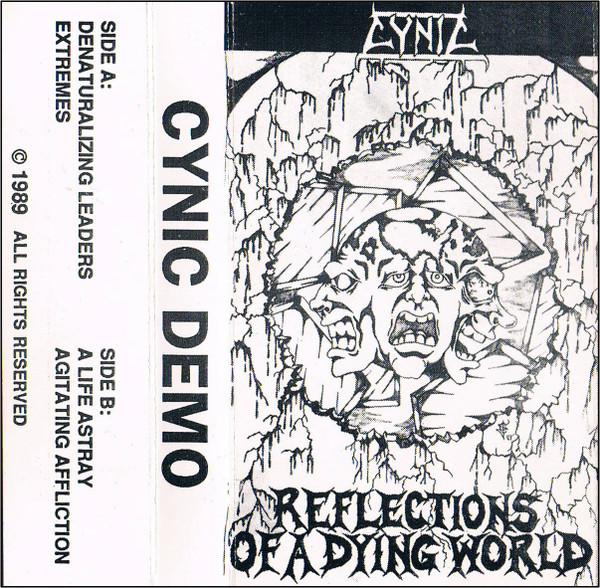
Before they weathered natural disasters, equipment detainment and band member departures and released their seminal 1994 LP Focus, jazzy//technical/progressive death metallers Cynic were a technical thrash/death metal band. A really, really good one.

Many folks can't get down with the fusion/jazz influences and vocoder vocals so prevalent in Focus and their newest, Traced in Air. I personally think they have a lush and substantially refined take on the "Chick-Corea-meets-death metal" concept Atheist arguably started, but anyway, these demos will please anyone who a) likes technical metal, b) hates that "dumb jazz shit" on Focus or c) wants to trace the band's progression literally year-to-year, this post is for you.

I do mean it about the last point. Included in the ZIP file are four demos: '88, '89's Reflections of a Dying World, '90, and '91, which features tracks "The Eagle Nature" and "Uroboric Forms" mostly devoid of the major jazz influences that would come to be on the Focus versions. Paul Masvidal also has a roar on par with Chuck Schuldiner, in my humble opinion (he later ditched this in favor of the vocoder when a doctor warned him throat damage was imminent). He and Jason Gobel's soloing remains totally sweet, and the latter two demos feature the masterful, go-to-90s-tech-death-metal-bassist Tony Choy (also of Atheist and Pestilence) skillfully and tightly holding down some excellent melodic bass lines.


The lineups vary a bit on each, so here's a rundown:

1988 Demo:
Jack Kelly - Vocals
Paul Masvidal - Guitar
Mark Van Erp - Bass
Sean Reinert - Drums


Reflections of a Dying World (1989):
Paul Masvidal - Guitar, Vocals
Jason Gobel - Guitar
Mark Van Erp - Bass
Sean Reinert - Drums


1990 and 1991 Demos:
Paul Masvidal - Guitar, Vocals
Jason Gobel - Guitar
Tony Choy - Bass
Sean Reinert - Drums

Saturday, December 13, 2008

Happy Birthday/RIP Chuck Schuldiner

I first started checking Death out towards the end of high school, when I heard they really advanced from the formula of traditional death metal-- a musical genre I shyed away from at the time-- and added melody, technicality and lyrical depth. So I started with The Sound of Perseverance and more or less worked my way back through the catalog. I can't say I'm as diehard a Death fan as I am Coroner or Opeth or other bands, but I have immense respect for Chuck's advancing the death metal template, his guitar styles and techniques, and the introspection he brought to his songwriting.

Had he not died of complications from a brain tumor, Chuck would have been 41 on December 13, 2008. In his honor, I will spread the awesome via this fantastic crowd bootleg from the Symbolic tour. The Engrish in the title is great...gotta love Japanese fans!

Monday, November 10, 2008

Squidlair Radio Playlist 11/4/08

Election Special- political songs! Yay Obama!

The Nils- Wicked Politician
Rage Against the Machine- Take the Power Back
Public Enemy- Fear of a Black Planet
Corrosion of Conformity- It Is That Way
Slayer- Mandatory Suicide
Megadeth- Tornado of Souls
Neil Young- Southern Man
Refused- Liberation Frequency
Soundgarden- Into the Void (originally recorded by Black Sabbath)

Saturday, November 1, 2008

Squidlair Radio Playlist 10/28/08- Halloween/Spooky Music Special

Tried to mix it up a bit, but ended up with a lot more metal than usual! Not a bad thing. The idea was to have music that sounded scary, but wasn't necessarily Halloween-themed.
Goblin- L'Alba Dei Morti Viventi
Schoolyard Heroes-
Curse of the Werewolf
Opeth- Demon of the Fall
The Misfits- Teenagers from Mars
The Misfits- Skulls
Thrushes- Halloween
Mercyful Fate- A Dangerous Meeting
Black Sabbath- Into the Void
Iron Maiden- Children of the Damned
Comus- Diana
Watain- Underneath the Cenotaph

Wednesday, October 1, 2008

Interview with Mike Browning of NOCTURNUS


Nocturnus were a band I'd heard about for some time, but only got around to investigating this summer thanks to their constant mention in the almighty Metal Inquisition. Thanks Lucho Metales, Awakening, Gene Hoglan's Balls and Sergeant D.


In summary of their awesomeness, I will say this: there are plenty of raw, shredding 90s Florida death metal bands, but how many had a full-time keyboardist, a singing drummer and songs that opened with lyrics like "ENTER THE DROIDS"?

Nocturnus had all these things, and sweet cover art by the immortal Dan Seagrave. A weird cyborg dude using some gizmo to unlock something. Hence the album being titled The Key.

As sci-fi and death metal are two of my favorite things, my curiosity was more then piqued. I also wanted to pick Mike's brain about his purported backstabbing by the other four members in the early 90s. Quite an interesting story.

True to the words of my buddy Steve Flynn, Mike was a class act dude and gave thorough, honest answers.

Please note: This interview and others will be appearing a zine some friends and I are doing at some point this year. More details as they arrive. Without any further ado...

How did you first grow interested in metal music? What was your first memory of discovering death metal?
Well, I was into metal way before there was even anything called death metal! Of course my first stuff was Black Sabbath and then I heard Angelwitch, Venom and Mercyful Fate and that was it, I knew what I wanted to do!

At what point did you decide to sing in addition to your drum duties? Was Morbid Angel the first band you did this in?
Yes, Morbid Angel was actually the first band I was ever in. We went through a few singers in Morbid Angel and it got to the point where I just said “fuck, let me try singing.” And since Trey and I pretty much wrote all the lyrics together, I thought it couldn’t hurt to try singing since I actually understand and am really into what the lyrics are about.

Did you and Chris Reifert from Autopsy ever swap tips?
A long time ago we wrote back and forth a few times, but I have never actually met him in person. He was always a very cool guy though.

How difficult was singing and drumming simultaneously, initially? Whenever singing/playing an instrument, rhythmic consistency is a given, but drums seem to be a very cardiovascularly demanding instrument.
Well I have been doing it so long it’s just kind of natural now for me, but using a headphone mic actually makes it a lot easier. Once I really get a good memorization of the lyrics to where I don’t have to think about what I am singing, then I can really get into just becoming the song instead of playing it!

In your interview with the now-famous Hard ‘n’ Heavy magazine Grindcore special video, your drumkit looks rather large; how many pieces were in it? Is it the same today?
That was a huge drum set that I had back then, two kicks and eight toms including the floor tom. That was one of the reasons why Earache had wanted Nocturnus to have a frontman because live all you could see was a big drum set and a voice coming from behind it. But now I use a vintage 1970’s Ludwig clear Vistalite kit with double bass and just four toms. But the drums are clear, so you can actually see me now right through my kit.

In Choosing Death: The Improbable History of Death Metal and Grindcore, you claim that David Vincent copied your vocal style and improved upon it. Where did your style come from?
Well, it’s quite obvious when you hear the way Gayvid Vincent sings on Altars (of Madness, Morbid Angel’s 1989 debut) as compared to Blessed (Are the Sick, 1991) that he was trying to sing like what I did on Abominations (of Desolation, Morbid’s scrapped first album) in 1986. I would say that my vocals were similar to chanting and a lot of chanting is done along with drumming, so it actually fits quite well. But I really got my style from chanting spells from The Necronomicon.

Conceptually, how was Nocturnus conceived? There were occult/anti-religious elements, but also heavy doses of sci-fi storytelling. Where did the idea to add the sci-fi themes come from? Where any authors of particular influence?
I came up with the name in 1987 after the band Incubus that I was in split up. I had wanted to do a band all about the occult. Something similar to Morbid Angel, but still different from that too. The science fiction parts of Nocturnus were really more of Mike Davis’ influence. The first Nocturnus demo was mainly occult and satanic subjects as far as the lyrics, and that was before Davis had even joined the band. So when the lineup changed and we did The Science of Horror demo, it was more of a mixture of science fiction and the occult. I am definitely into science fiction stuff myself, but it wasn’t much of an influence on what I did musically. When Davis had some cool ideas, we decided to blend the two together and do some songs about it. I would say some of my favorite science fiction authors are Larry Niven, Jerry Pournelle, Isaac Asimov and generally the older sci-fi authors like them.

At what point was the decision made to include keyboards in the band’s music?
Well, we really only wanted to have some keyboard intros for the next demo, but when we brought the keyboard player in to hear the intros that he was working on for us, we tried using him in a few parts of the songs and it worked quite well, so we decided to make him a band member.

What exactly is the cyborg creature unlocking on the cover of The Key?
He is actually the human that is talked about in a couple of the songs like “Droid Sector,” “Destroying The Manger” and “Empire of The Sands.” He is in a cyborg suit to keep himself alive after the Andromeda Strain virus plagued the Earth. He is sitting in his time machine and he is holding the key that he discovered in the aliens’ ship. The Key itself is the thing that makes the time machine function, so he can go back in time and destroy Jesus and take over the Earth.

The Grindcrusher tour with Napalm Death and Godflesh sounds like it was massive– any particular memories? Were you on good terms with the Morbid guys?
Morbid Angel was not on the Grindcrusher Tour, it was only Napalm Death, Godflesh and Nocturnus. (Whoops- ed.) But yeah the tour was an awesome tour and ever since I have remained really good friends with the Napalm guys! As far as Morbid Angel, I don’t really get along with them, they have those I-am-better-than-you rock star attitudes, which I hate anyway!

Before recording Thresholds in 1992, Nocturnus inducted a full-time vocalist, Dan Izzo. Why was this decision made?
It was first something that the record company Earache thought would be a good idea so that the band would have a frontman and a focal point since I was behind a big drum kit and the other guys in the band barely moved around on stage. It was something I was definitely against doing but everyone else in the band thought it would be a great idea. And as history shows it was not a good idea at all as Thresholds sold only about a third of what The Key did. When we toured for Thresholds, every night people were asking why I wasn’t singing anymore, which caused even more tension in the band. The fact that I was right and should have stayed as the singer was probably why they felt they needed to get rid of me completely so that pressure for me to be the singer again was not there anymore. As you can see, the band only lasted less than 6 months after they fired me and was dropped by Earache and broke up.


Was “Subterranean Infiltrator” about Snake from the Metal Gear video game series? Mike Davis’ (guitar) Wikipedia page suggests it was.
I don’t even think Metal Gear was even invented in 1991 when that song was written (Actually, the first Metal Gear came out in 1987. --ed.) I only contributed to a very small amount of the lyrics on Thresholds, so where Davis got that idea I am not really sure. By then, my only involvement in Nocturnus was playing the drums.

The initially dissolution of the Nocturnus lineup was due to legal action by Louis Panzer (keyboards), Sean McNenney (guitar) and Davis. What was your experience? How and why did it all happen? Is there still bad blood today?
Louis Panzer was the reason Nocturnus failed the first time and again when they tried to reunite in 2000. He destroyed Nocturnus with his jealousy. He wanted to run the band, and you see where that got him! It was all Lou’s idea to go behind my back and steal and trademark the Nocturnus name that I created. The others just sort of followed him. I still talk to Davis occasionally, and we have even jammed a few times, but he doesn’t want to play in a band ever again since even he was burned by Panzer, McNenney and Emo Mowery. I don’t care how much money they offer me-- I will not ever play in any band with Lou or Sean. For me, it’s a matter of what I believe in, not how much money I can make.

This fall, you are touring Europe as Nocturnus. How are you legally able to do this? How does your newer band, After Death, compare to what you were doing in Nocturnus?
Yes, my band After Death will be touring Europe for 13 shows in October and we are going as Nocturnus. The promoter’s lawyers have found a legal loophole that says that a name trademarked in the US is only good in the US, so in Europe I can use the name Nocturnus. We are only playing songs from The Key, where I wrote most if not all of the lyrics and helped work on the music of every song off that album. We will also be playing a few of the old Morbid Angel songs that I did the same with off of Abominations of Desolation. I was only credited for a few of the lyrics on Abominations, but really it was just Trey and I who put that whole record together, so I think I should be able to play and have some claim as to the amount of creativity, work and effort I put into both of those bands.
To me, After Death is the synthesis of all of my former projects and bands all rolled into one, with even more new elements added as well.

You practice and study the occult. What spiritual ideas and elements do you specifically follow?
The occult is huge a huge spectrum that I don’t think I will ever be done learning and adding in elements as to what I do with it. When I was very young-- around 14-- I began with witchcraft and Satanism and then was introduced to The Necronomicon, but I never stopped there. I just kept reading and collecting books and material and branching out further and further on occult subjects like Crowleyism, Kaballah, Tarot, Egyptian, Sumerian and Babylonian magick and Left Hand Path studies. For me, there is always something that I am reading and learning so that I will never follow any one thing. I will just take everything I have learned and add it to my own system that works for me!

Thanks for your time! Anything you’d like to say in closing?
Just thanks to everyone that has supported what I have done through all these years, and I hope that everyone will come out and see this tour in October and check out After Death!

Nocturnus MySpace
Official After Death MySpace

Saturday, July 12, 2008

Their Presence is Unquestionable


Atheist were a Floridian technical death metal band and one of the first to incorporate jazz elements into their sound. Their first record, Piece of Time, was a ragin' disc of death/thrash and a very promising debut. The band really came into their own, however, on 1991's Unquestionable Presence. The only traditional death metal element present was Kelly Shaefer's rasp-- but even then, he was one of the more intelligible extreme vocalists of the era. Shaefer and Rand Burkey's guitars clashed over or played with the insane bass style of Tony Choy (who recorded the lines written by original, amazingly promising bassist Roger Patterson, the unfortunate victim of a tour van crash) and the jazzy, almost melodic drumming style of Steve Flynn.

The band reunited and played a whole bunch of festival appearances throughout 2006 and 2007. I was very fortunate to meet, see, and hang out with the guys (including live guitarists Sonny Carson and Chris Baker, filling due to Shaefer's carpal tunnel and Burkey's legal troubles) at their first US show in 13 years for Baltimore's 2006 Auditory Assault Fest. Great guys, amazing set, and overall one of the best nights of my life.

The interview I did with Steve, Kelly and Tony was first published in my school's newspaper, but as of this week it's been published in the fine, long-running metal/punk/grind zine Disposable Underground, written by Richard Johnson of grind 'n' rollers Drugs of Faith. Every single issue he's ever written can be downloaded in PDF form and is worth your attention if you're into any sort of extreme music. Back in the day, he did quality interviews with Carcass, Discordance Axis, Napalm Death, Gorguts, and a bazillion more. Richard will also send you a copy of the zine free of charge, should you want a print copy.

Back to my interview, though-- it's not my best piece, writing-wise. With that said, however, the band's answers are quite awesome and quite thorough. Have a read through some of Richard's stuff, too– he's a great journalist.

If you're scratching your head wondering what the hell jazz and death metal sound like when they're mixed, try their classic "An Incarnation's Dream" on for size.

Atheist- An Incarnation's Dream